It has now been a week since we once again hopped on an
airplane and flew halfway around the world.
However, this journey was anything but ordinary. First, it was coming three months later than
had originally been planned. Of course,
that’s what happens when you land in Canada for a home assignment right as a pandemic
is exploding around the world! Second,
as we finally return to Rwanda six-and-a-half months later, the pandemic is
still ravaging much of the world.
In the days leading up to our departure, many people asked
us what it would be like to fly during COVID-19. Naturally at that point, we couldn’t yet
answer their questions. We could tell
them the many things we had to do before leaving, which included arranging to
have a COVID-19 test done no more than 120 hours before departing. (It turned out we had to show this document
each step of the way.) But, until we
actually did the journey, we didn’t know for certain what the experience was
going to be like – although we had some ideas of what to expect.
So now that we are safely back in Rwanda, it’s time to
answer the questions. Here are the types
of things we experienced:
Masks…all the time!
From the time we entered the airport to go through security in Moncton,
for the next 30 hours we had to keep our masks on. The only time we could take them off was when
we were eating. That was a long time to
wear masks continuously. Our great
respect goes out to front-line workers and others who are having to wear those
little devices for long periods at a time!
 |
Goodbyes had to happen in the airport parking lot
|
 |
| Masks on: Final goodbyes with Bronwyn & Caleb |
Where did everybody go? Unsurprisingly, the airports were not the
teeming mass of people that they usually are.
It’s one thing to be sitting at home hearing about the lack of air
travel going on. But to experience it
first-hand was quite amazing. The
airports were significantly quieter. Our
airplane from Montreal to Brussels was only partly full. We ended up in a set of three seats with no
one else, so we could spread out a bit with a seat in between us. (That pleasant circumstance never seems to
happen to us, so that made the trip a little more enjoyable.) In Brussels we
usually have to switch terminals for the flight to Kigali. But this time we didn’t. Our guess is that the lower passenger volume made it unnecessary
to be staffing an additional terminal.
 |
| The Montreal Airport: Almost a ghost town |
 |
| The Montreal Airport: Even Starbucks was closed! |
 |
| Our gate in Montreal only 10 minutes before boarding! |
Service with a smile, we think! The flight attendants are obviously in a
position of higher risk, having to interact with so many passengers in order to
look after their needs. So it makes
sense for them to be wearing a higher level of protective gear. But to know it in your head is one thing. It is another to see the attendants on
the Air Canada flights fully gowned up as they serve you a meal. (We’re quite sure there was usually a smile
behind the mask.) Note: We were a bit
surprised that on the Brussels Air flight from Brussels to Kigali they only had
masks as their “extra equipment”.
 |
| Air Canada flight attendants serving a meal |
Prepackaged everything! Both times we stepped onto the Air Canada
flights (in Moncton and in Montreal) we were handed a sealed plastic bag which
contained several “necessities” in the context of the coronavirus. There was a small bottle of water, a mask, a bag
of pretzels, two alcohol swabs, a wet wipe and a small bottle of hand
sanitizer. All very handy. And their meals were different too. They were even more packaged than usual, with
each item sealed individually. And there
was no choice either – "one size fits all".
Note: In contrast, the meals on the Brussels Air flight were the same as
usual.
 |
| Cold meal in a box |
Different strokes for different folks! As it was in Canada, passengers respond to
COVID-19 in different ways depending on their needs, personality, culture, etc. The rules clearly stated that masks must be
worn, which everybody did – though it must be said that some only covered their
mouth with their mask, and at least one woman balked at having to wear it on
the plane. (Go figure!) But for some people, a simple mask was not enough. We saw everything from face shields all the
way up to full body coverings!
 |
| Everyone turned to look at this passing group |
New arrivals. Our
return to Rwanda was different from all previous arrivals. We landed at 12:45 am early Sunday morning. Once we had our visa and luggage, we were transported by shuttle to a hotel where a medical
worker did another COVID-19 test on us.
We then went to our room where we had to remain in isolation until we
received word of a negative result from the test. Thankfully everything went smoothly and by 10
am on Monday we were finally home again – greeted warmly by our cat Messi and
by all the unpacking and settling in needed after being away 6.5 months.
 |
| Laura Lee catching up on lost time with Messi |
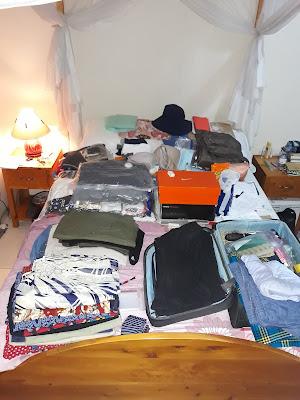 |
| And then it's time to unpack |


